Địa điểm của chúng tôi
304 Phố North Cardinal.
Trung tâm Dorchester, MA 02124

304 Phố North Cardinal.
Trung tâm Dorchester, MA 02124
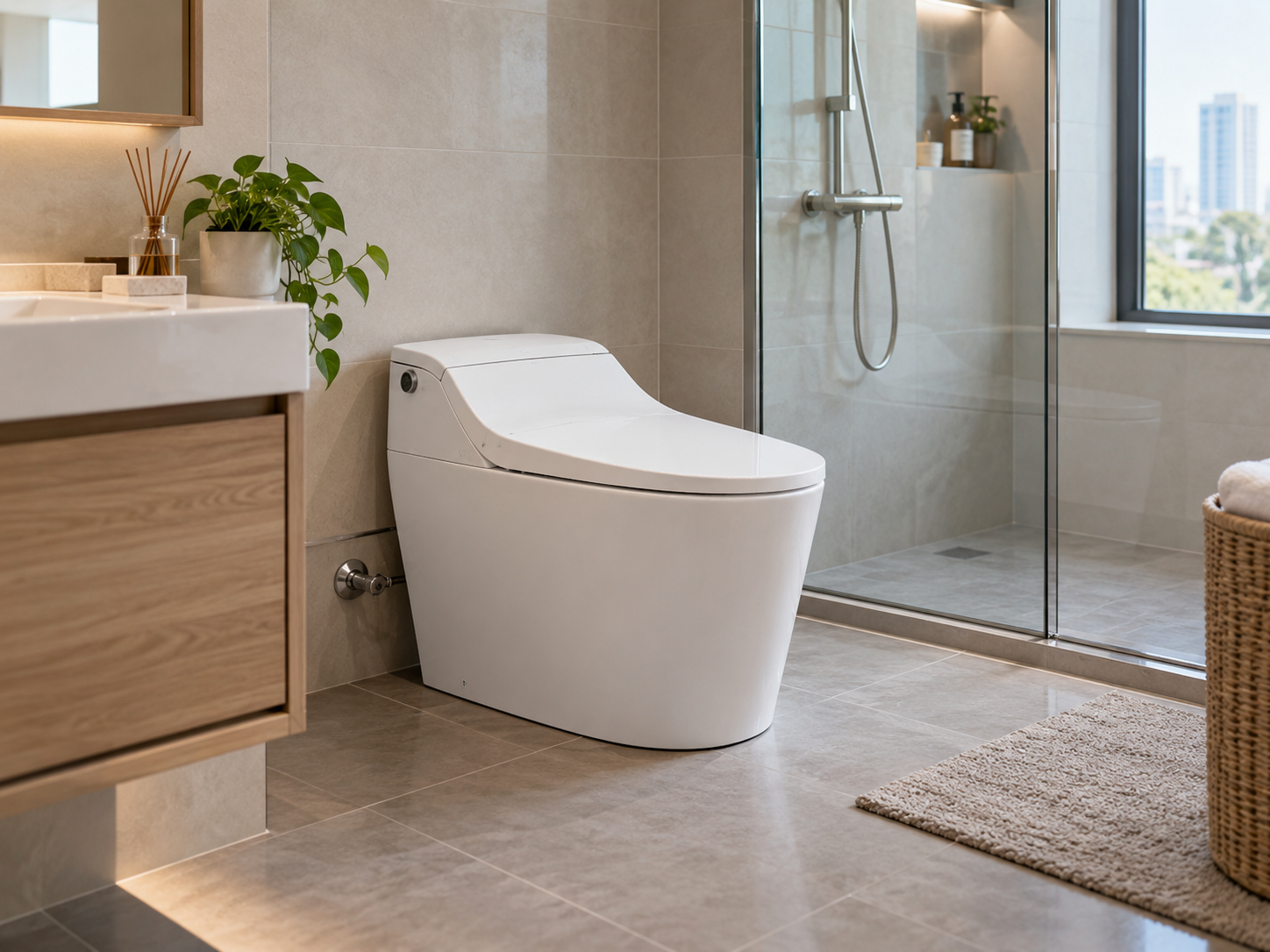
Smart toilets are becoming increasingly popular in residential, hotel, apartment, and commercial bathroom projects. However, one technical issue can significantly affect their performance: water pressure.
Many conventional tankless smart toilets rely heavily on the incoming water supply to generate sufficient flushing power. In buildings with unstable or low water pressure, flushing performance may become inconsistent. This is particularly relevant for older buildings, upper-floor apartments, gravity-fed water systems, villas, hotels, and markets where municipal water pressure varies throughout the day.
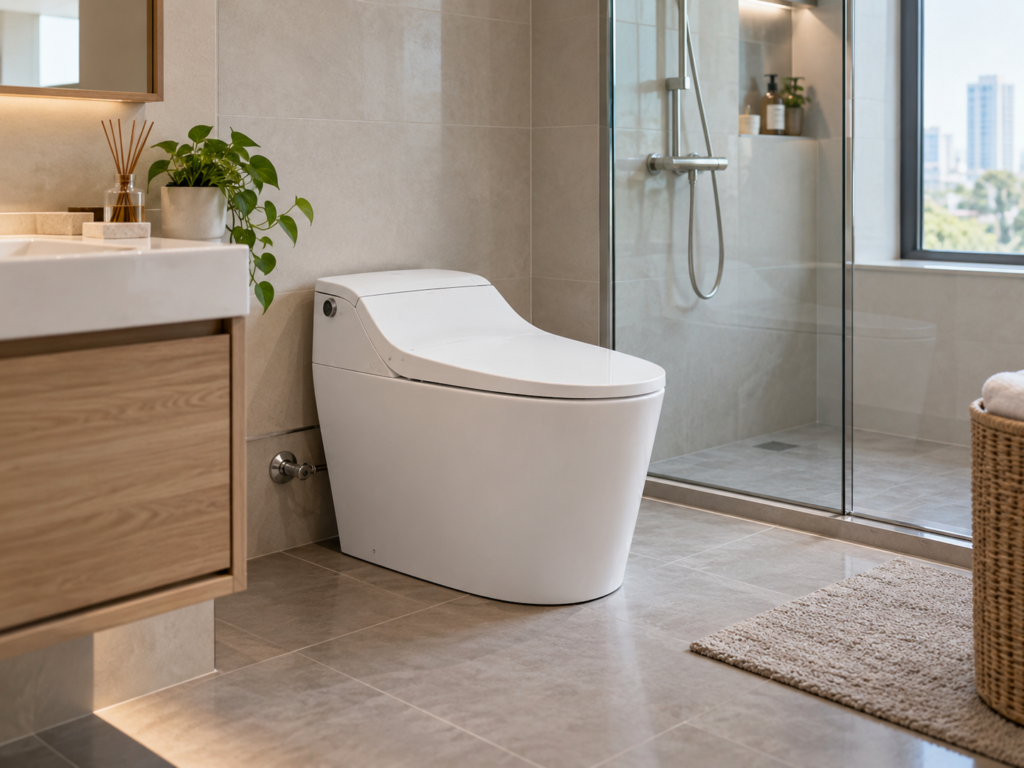
A smart toilet with a built-in water tank provides a practical alternative. By storing water inside the toilet and using a controlled flushing system, the toilet can provide more consistent flushing performance even when the external water supply is relatively weak or unstable.
For distributors, importers, project contractors, and sanitary ware brands, understanding how this system works is important before selecting a model or placing a bulk order.
Traditional tank toilets store water before every flush. When the flush is activated, the stored water is released quickly to create the required flushing force.
Many modern tankless smart toilets work differently. They may depend directly on the building’s incoming water pressure. When sufficient dynamic pressure and flow are available, this system can provide a strong flush while maintaining a compact toilet body.
The challenge appears when the installation environment has inadequate or unstable water pressure.
Possible problems include:
For this reason, importers should not evaluate a smart toilet only by its appearance, electronic functions, or price. The flushing architecture should also match local plumbing conditions.
Industry suppliers commonly distinguish direct-pressure or tankless systems from built-in-tank or pump-assisted designs, with the latter generally offering more consistent flushing where incoming pressure is low or variable.
A built-in water tank smart toilet integrates a compact water storage system inside the toilet body.
Instead of depending entirely on instantaneous mains pressure, the toilet stores water before the flushing cycle.
A typical sequence works like this:
Water from the building supply enters a concealed internal reservoir.
Because filling can take place gradually, the system is generally less dependent on having strong instantaneous water pressure during the actual flushing moment.
The internal tank keeps a controlled amount of water ready for use.
This helps separate the flushing cycle from short-term fluctuations in building water pressure.
Depending on the model, flushing may be triggered by:
The stored water is rapidly delivered into the ceramic flushing channel.
Some designs also use an integrated booster pump to increase water velocity and maintain consistent flushing force.
After the flushing cycle, the internal tank automatically refills and prepares for the next use.
This architecture is why built-in-tank models are often selected for installations where direct-pressure flushing is considered risky.
Several current commercial designs combine a concealed tank with pump-assisted flushing specifically to maintain flushing performance under lower supply pressure.
Both systems have advantages. The correct choice depends on the destination market and installation environment.
| Mặt hàng | Built-In Tank Smart Toilet | Tankless Smart Toilet |
|---|---|---|
| Dependence on incoming pressure | Lower | Higher |
| Low-pressure adaptability | Better | Depends strongly on model |
| Flush consistency | Generally more stable | Sensitive to supply conditions |
| Internal structure | More components | Relatively simpler water path |
| Toilet body size | May be slightly larger | Often more compact |
| Pump option | Common on some models | Depends on design |
| Best application | Mixed or low-pressure markets | Stable high-pressure plumbing |
Importers should avoid assuming that one architecture is universally better.
A tankless system can perform very well when the plumbing conditions meet its requirements. A built-in tank is particularly valuable when the importer cannot guarantee consistent water pressure across every installation.
Built-in tank models are particularly useful in markets where plumbing conditions vary significantly.
Water pressure can differ between floors. Buildings may also use booster systems that create pressure fluctuations.
Older pipes, smaller pipe diameters, aging valves, or partially restricted plumbing can reduce available flow.
Some houses depend on rooftop tanks, gravity-fed systems, wells, or private pumping systems.
Hotel projects require consistent flushing performance across many rooms. Differences in pipe length and floor level can affect pressure.
Developers often prefer products that can tolerate a wider range of plumbing conditions to reduce installation risks.
For distributors selling through multiple channels, it may be impossible to know the exact water pressure in every customer’s bathroom.
A built-in tank can therefore provide a wider installation tolerance.
For B2B procurement, the words “low water pressure” or “zero pressure” should never be treated as sufficient technical information.
Buyers should request actual specifications.
Ask the supplier:
What is the minimum inlet pressure required for stable operation?
Do not only ask whether the toilet “supports low pressure.”
Request a numerical value and corresponding test conditions.
Also clarify whether the quoted pressure refers to:
These values are not necessarily the same.
Pressure alone does not determine performance.
The plumbing system must also provide adequate flow.
Yêu cầu:
Some smart-toilet specifications list both an operating pressure range and a minimum flow requirement, illustrating why buyers should confirm both rather than focusing on pressure alone.
The supplier should be able to explain:
For hotels and commercial installations, refill performance can be especially important.
Not all built-in tank toilets use the same system.
Ask whether the model uses:
For pump-assisted models, buyers should also understand pump power, expected service life, noise level, and replacement procedure.
Request actual flushing test information rather than relying only on marketing descriptions such as:
Ask the supplier to provide test videos or sample testing before bulk production.
Testing can include:
Smart toilets must match the customer’s drainage configuration.
Confirm:
Common dimensions differ by market, so OEM suppliers should confirm the destination country before production.
A smart toilet combines water and electrical systems, so electrical specifications are critical.
Confirm:
These specifications should match the destination market.
Not every market requires the same functions.
Typical options include:
For distributors, it is often better to define several product configurations rather than purchasing one fully loaded specification for every market.
This point is frequently overlooked.
Hỏi:
Can the toilet flush when electricity is unavailable?
Depending on the product design, emergency flushing may be operated through:
This feature can be important in regions with unstable electricity supply.
A built-in tank introduces additional components compared with a simple ceramic toilet.
Buyers should confirm availability of replacement parts such as:
For distributors, maintaining a small spare-parts inventory can significantly improve after-sales service.
Low water pressure is not the only plumbing issue.
Hard water, sediment, rust, and impurities can affect:
For markets with poor water quality, buyers should ask whether the product includes an inlet filter and whether replacement filters are available.
An accessible filter design also makes maintenance easier.
For project procurement, product selection should consider more than individual consumer features.
Hotel and apartment buyers usually care about:
It is therefore useful to select a smart toilet platform that can remain available for several years rather than choosing a short-lived consumer model.
Before confirming a sample or purchase order, we recommend requesting the following information:
Product model:
Confirm the exact model number.
Flushing system:
Built-in tank, pump-assisted, siphonic, direct flush, or hybrid.
Water pressure range:
Specify minimum and maximum operating pressure.
Minimum flow requirement:
Confirm required water flow.
Tank configuration:
Ask about capacity and refill behavior.
Drainage:
Confirm S-trap/P-trap and rough-in.
Voltage:
Confirm destination-market voltage and frequency.
Plug:
Specify local plug standard.
Functions:
Confirm the exact feature configuration.
Ceramic color:
White, black, gray, or customized.
Logo:
Confirm private-label requirements.
Packaging:
Standard export carton or customized packaging.
Manual:
Confirm required language.
Certification:
Confirm which certification or compliance documents are required for the destination market.
Order quantity:
Provide expected sample quantity and annual purchasing volume.
This information allows the supplier to recommend a more appropriate product configuration.
For private-label smart toilet projects, built-in tank models can usually be configured for different markets.
Possible customization includes:
Logo printing or marking on:
Functions can often be selected according to the target price level.
Ví dụ:
Standard Version
Advanced Version
Add:
Premium Version
Add:
Depending on the product, options may include:
OEM packaging can include:
For new distributors, we strongly recommend evaluating physical samples before placing a bulk order.
The sample should be tested under conditions similar to the destination market.
Important tests include:
For large projects, installation testing in an actual bathroom environment is even more valuable.
Two smart toilets may look almost identical but use very different internal water systems.
A model that works well in the supplier’s showroom may perform differently in a low-pressure building.
Even products designed for low-pressure environments still require an incoming water supply to refill the internal tank.
The important question is how much pressure and flow are required for reliable operation.
Electronic and hydraulic components may eventually require replacement.
Importers should evaluate after-sales support before selecting a supplier.
Voltage, rough-in, plugs, certifications, water pressure, and user preferences vary by country.
Product configurations should be adapted accordingly.
When contacting a smart toilet manufacturer, provide the following information:
With these details, the manufacturer can recommend a more suitable platform instead of simply quoting the cheapest model.
Built-in water tank smart toilets offer an important advantage for markets where incoming water pressure is low, unstable, or difficult to predict.
By storing water before flushing—and, in some designs, combining the tank with pump-assisted flushing—the system can provide more consistent performance across a wider range of installation conditions.
For distributors and project buyers, however, the phrase “built-in tank” alone is not enough.
Before placing an order, buyers should verify:
A successful smart toilet project starts with matching the product architecture to the actual plumbing conditions of the destination market.
We supply smart toilets for distributors, sanitary ware brands, hotels, apartments, and project buyers.
OEM and ODM options are available, including:
Send us your destination country, estimated quantity, water pressure conditions, rough-in size, and required functions, and we can recommend a suitable smart toilet configuration for your project.
Contact us for product specifications, samples, and factory quotation.
